When Geology Calls for a Scientific Approach
In geological exploration, results often emerge where practice meets science. A geophysicist develops a new method for interpreting magnetometry data to identify an ore body three kilometres below the surface. A geochemist tests a way to recover rare earth metals from the tailings of old processing plants. A mineralogist studies the composition of ore minerals to select the best processing technology. All of this is research and development, without which modern geology would be unthinkable.
R&D in our industry is not abstract research carried out for the sake of publication. It addresses specific tasks: building three-dimensional geological models for deposits with complex tectonics, developing methods to locate concealed ore bodies using secondary dispersion halos, and assessing man-made deposits in the waste dumps of Soviet-era mines. Every study directly affects project economics and the accuracy of forecasts.
Legislation is changing along with the industry. Since the end of 2025, funding for R&D in subsoil use has been subject to approval by the Ministry of Science and Higher Education. This makes the system more transparent, but requires companies to provide documented evidence of their competence to participate in research projects.
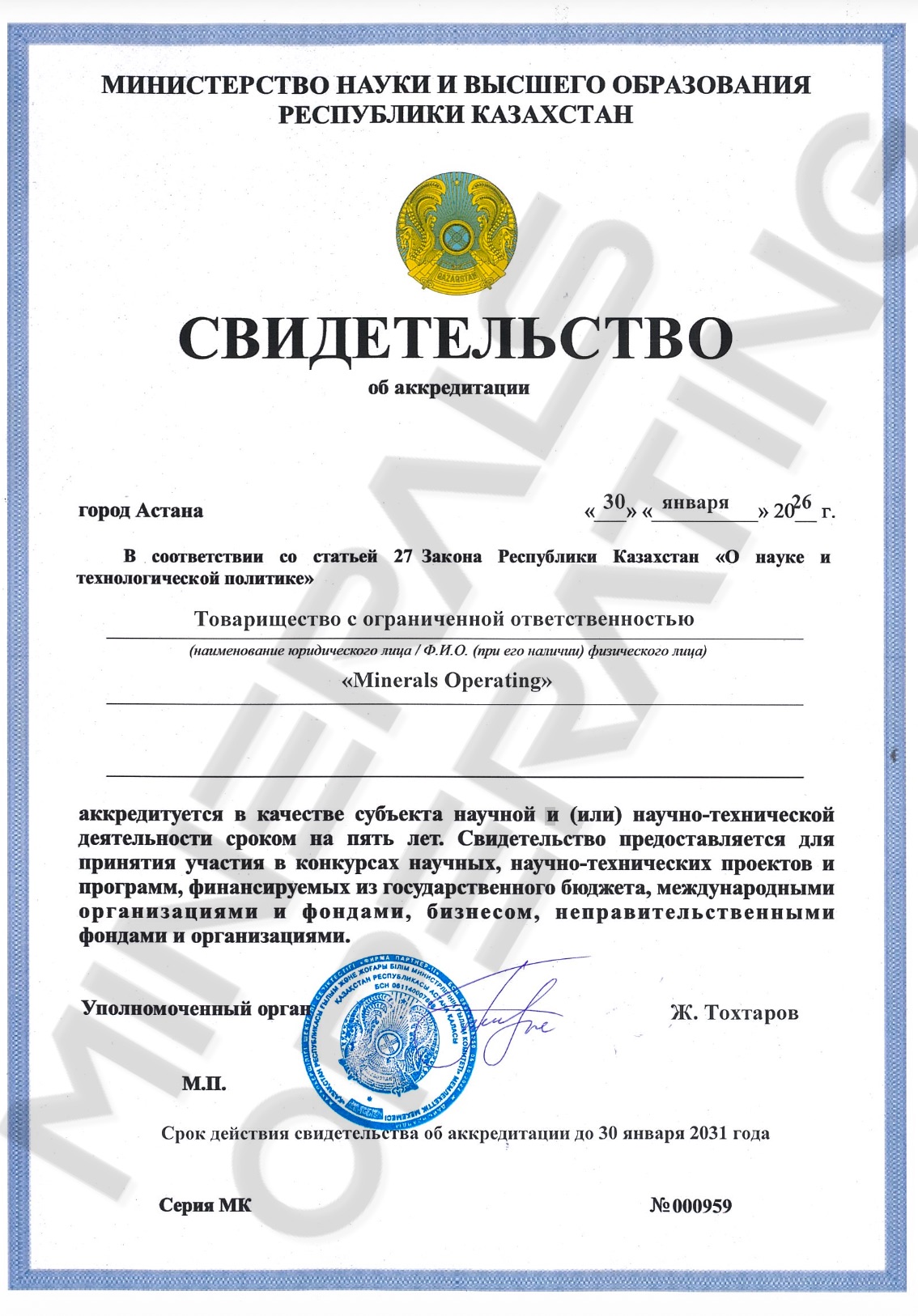
At Minerals Operating, we have just renewed our accreditation as an entity engaged in scientific and scientific and technical activities; the certificate is valid until 2031. For us, this is more than a formality. We regularly participate in research projects, from developing reserve estimation methods to introducing digital technologies into geological modelling. Science is built into our everyday work because every deposit is unique and there are no universal solutions.
Geology remains a science even when it becomes a business. And vice versa.
#ResearchAndDevelopment #GeologicalExploration #ScientificActivity #MineralsOperating #Kazakhstan #Accreditation #Mining #Innovation #ScienceAndPractice